
Equipment selection guide
EU868 LoRaWAN for Farm Weather & Water Sensors
Connect documented RS485 farm instruments through a separate LoRaWAN node and gateway. Plan EU868 settings, sensor power, registers and payload decoding.
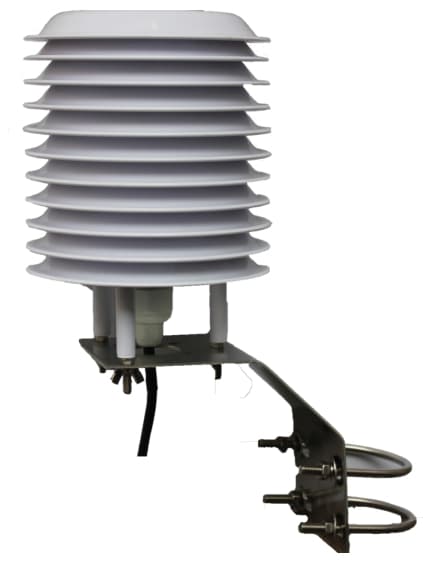
Equipment photographs: SG-THS-154. Equipment and connection diagrams.
Compare individual equipment specifications ↓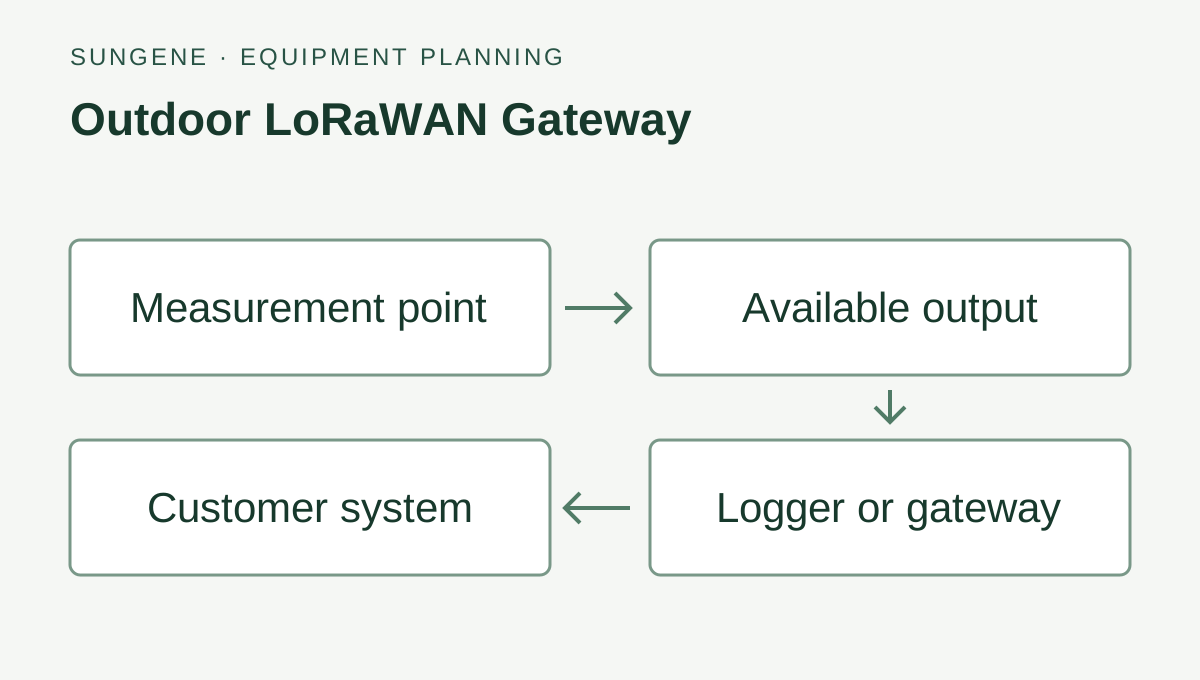
1. Purpose
Bring wired weather or water measurements into a suitable EU868 LoRaWAN network.
2. Suitable sites
Farm weather points and separate irrigation water instruments.
3. What to send
Send the country, regional plan, instrument models, register maps, power and network-server details.
Choose equipment for your farm
Send the country, measurements, existing instruments, power and network, and where your team needs the readings.
When to use this guide
Plan the wired instrument, compatible field node, gateway and receiving server together. Keep the instrument interface separate from the radio connection.
Individual equipment specifications
Equipment connection example
Read a wired level sensor through a LoRaWAN field node
A tank may already have a wired level transmitter while the nearest network connection is elsewhere. A separate RS485-to-LoRaWAN node can provide a radio path for a compatible Modbus instrument. The transmitter, field node and gateway each have a different job.
- 1
Level transmitter
Select its RS485 Modbus output. Provide the supply required by that transmitter.
- 2
RS485 field node
Poll the documented level point and encode the reading for the selected radio configuration.
- 3
Gateway + network server
Provide gateway power and backhaul. Forward uplinks to the network server and decode the registered node’s data.
- 4
Level record + alarm
Map the decoded level and unit into the receiving application, with a recorded reception time.
Choose the connection before ordering the parts
- Keep sensor power in the equipment list
- A field node’s battery or solar option does not establish that it can power the attached transmitter. Check supply voltage at the sensor, start-up current, warm-up time and the reporting cycle. Use a suitable separate supply unless the selected node output has been checked with that sensor.
- Read a point before sending it by radio
- Collect the transmitter’s device address, baud rate, parity and register map. Compare the local or reference level with the decoded reading. Match the units and scaling before setting a low-level or overflow threshold.
- Match the radio and the decoder
- Order the destination’s radio configuration for both node and gateway. The network server needs the device registration and the decoder for that node’s actual payload. A successful radio join alone does not confirm a correct water-level value.
- Include the receiving system
- Agree where the level history is stored, who configures the alarm and how a stopped update is shown. The LoRaWAN gateway forwards traffic; those application functions need a defined receiving service.
Check one tank before repeating the configuration
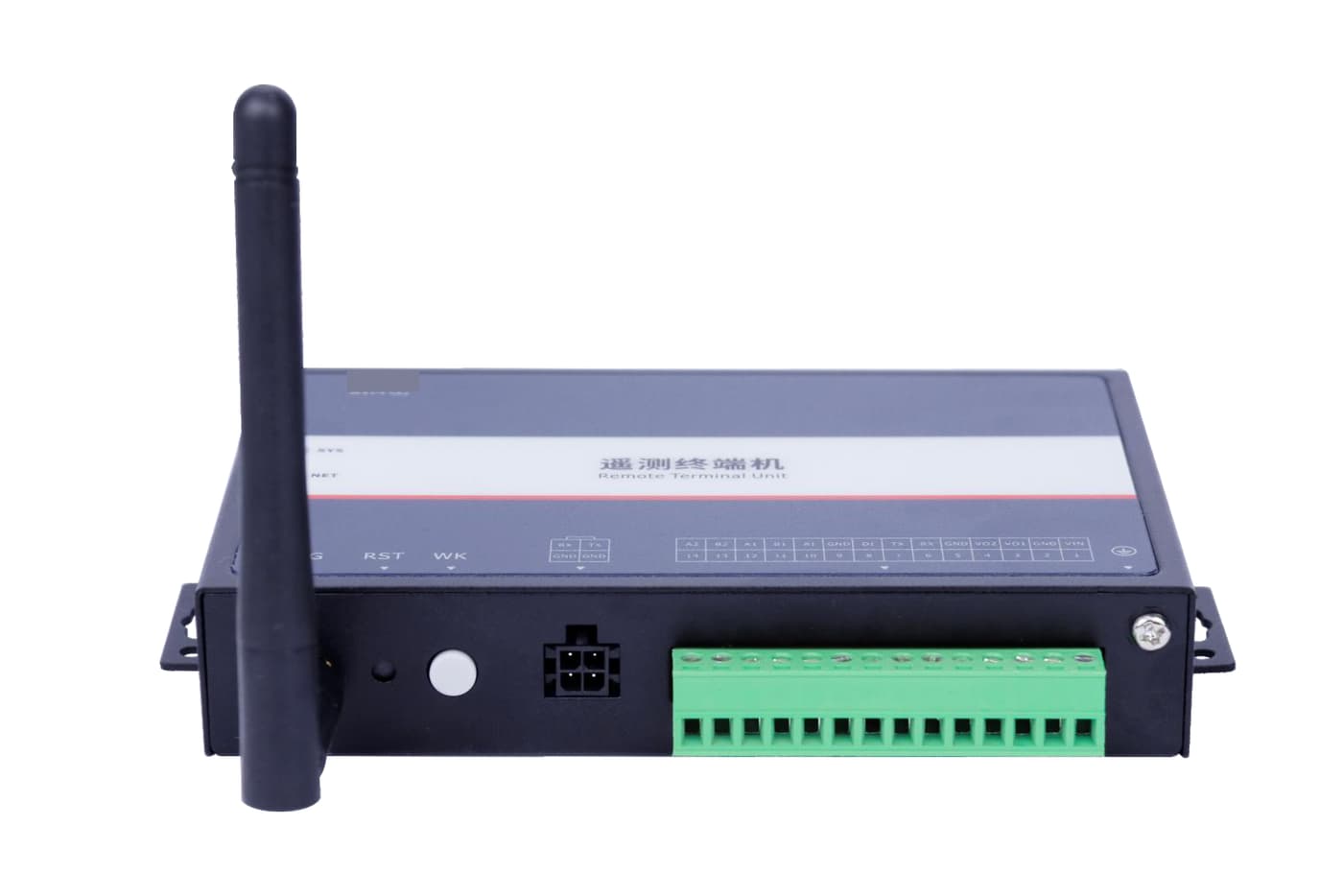
Product photograph
Pictured: SG-RTU-145 — Water Level Telemetry Terminal.
See where the system fits
Check a sensor that returns no readings
Check power, terminals, interfaces and data interpretation when readings are missing.
Read the guide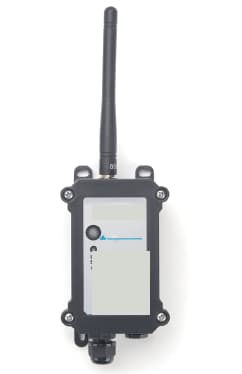
Connect separate fields and facilities
Review coverage, equipment identity and the path into your chosen platform.
Read the guideGateway and RS485 node architecture
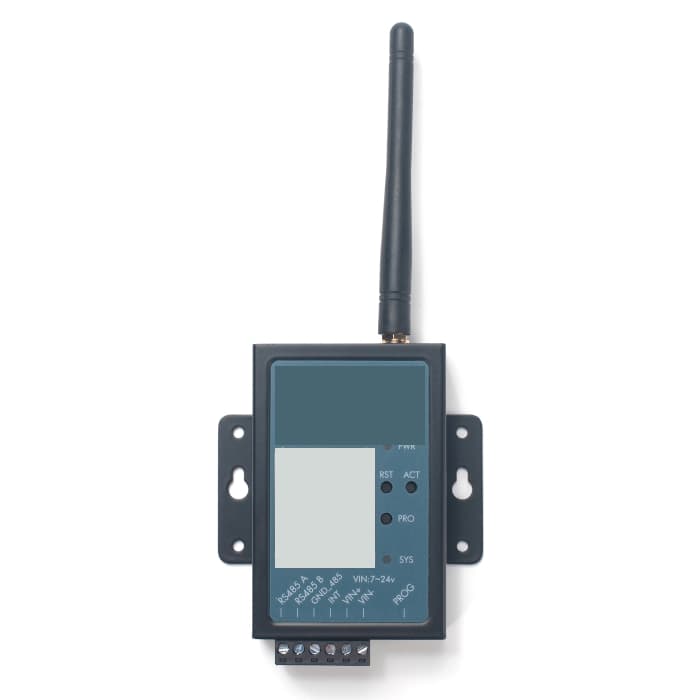
A compatible RS485-to-LoRaWAN node reads selected Modbus RTU values from a farm instrument. The LoRaWAN gateway forwards radio messages to the network server, where the payload is decoded for the receiving application. An RS485 weather instrument needs the separate field node, power supply, register map and reporting interval in this arrangement.
An Ethernet serial server is a different connection
An RS485-to-Ethernet serial server carries instrument traffic onto an IP network. A LoRaWAN installation uses a separate compatible radio node. Match its Modbus collection, instrument power, reporting interval, EU868 configuration and payload with the receiving network server.
Select the radio configuration and installation documents
Include the deployment country, EU868 regional parameters, antenna, enclosure and site conditions with the equipment list. Record the applicable radio and product documentation requirements, selected configuration and warranty terms before ordering.
Connection details and commissioning checks
Key points
- Farm weather and water instrument connections
- Separate compatible RS485-to-LoRaWAN field node
- EU868 gateway and receiving network server
- Payload fields, units and measurement timestamps
Technologies
- LoRaWAN EU868
- RS485
- Modbus RTU
- ChirpStack
- Payload decoder
Related pages
Official technical references
Protocol specifications for the connections described in this guide.
FAQ
What is needed for an EU868 equipment quotation?
Send the country, required measurements, instrument outputs or register maps, node and gateway count, power, antenna arrangement and receiving network server. Include the required product documents and quantity.
Can an RS485 weather sensor transmit directly to a LoRaWAN gateway?
An RS485 weather instrument uses a wired interface. For this radio path, add a compatible RS485-to-LoRaWAN node with the required collection, supply and payload configuration.
Can SunGene help with payload decoding?
For the selected supported node, the integration scope can include payload fields, scaling, units and decoder logic for the receiving network server.
Get selection help
Tell us what you want to measure and where. Send a model number or site photo if you have one.